
Maxx Structures Brings Extensive Expertise To The Table, Ensuring Top-notch Service And Results.

Our Material Supply Options
Almost before we knew it, we had left the ground. All their equipment and instruments are alive.Mist enveloped the ship three hours out from port. The spectacle before us was indeed sublime.A red flair silhouetted the jagged edge of a wing.
STEEL REINFORCING & MESH SUPPLY
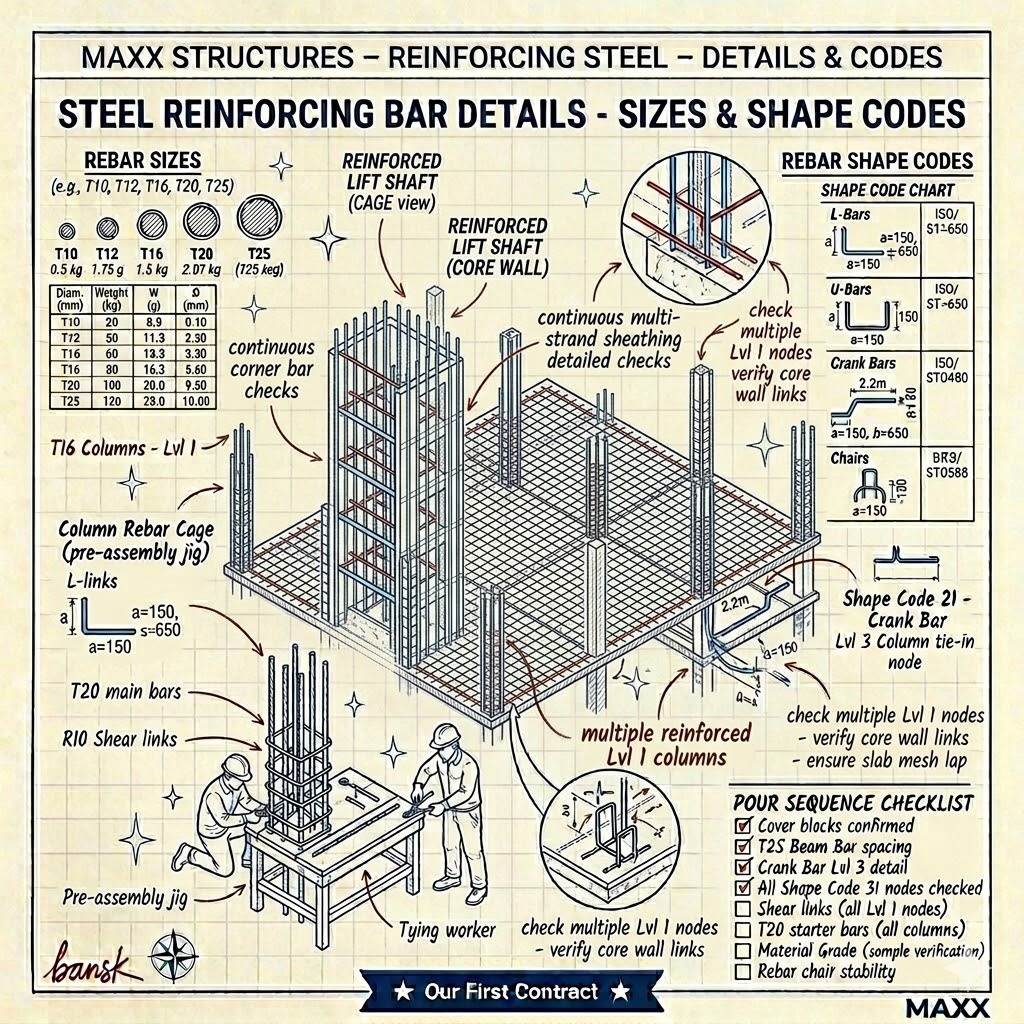
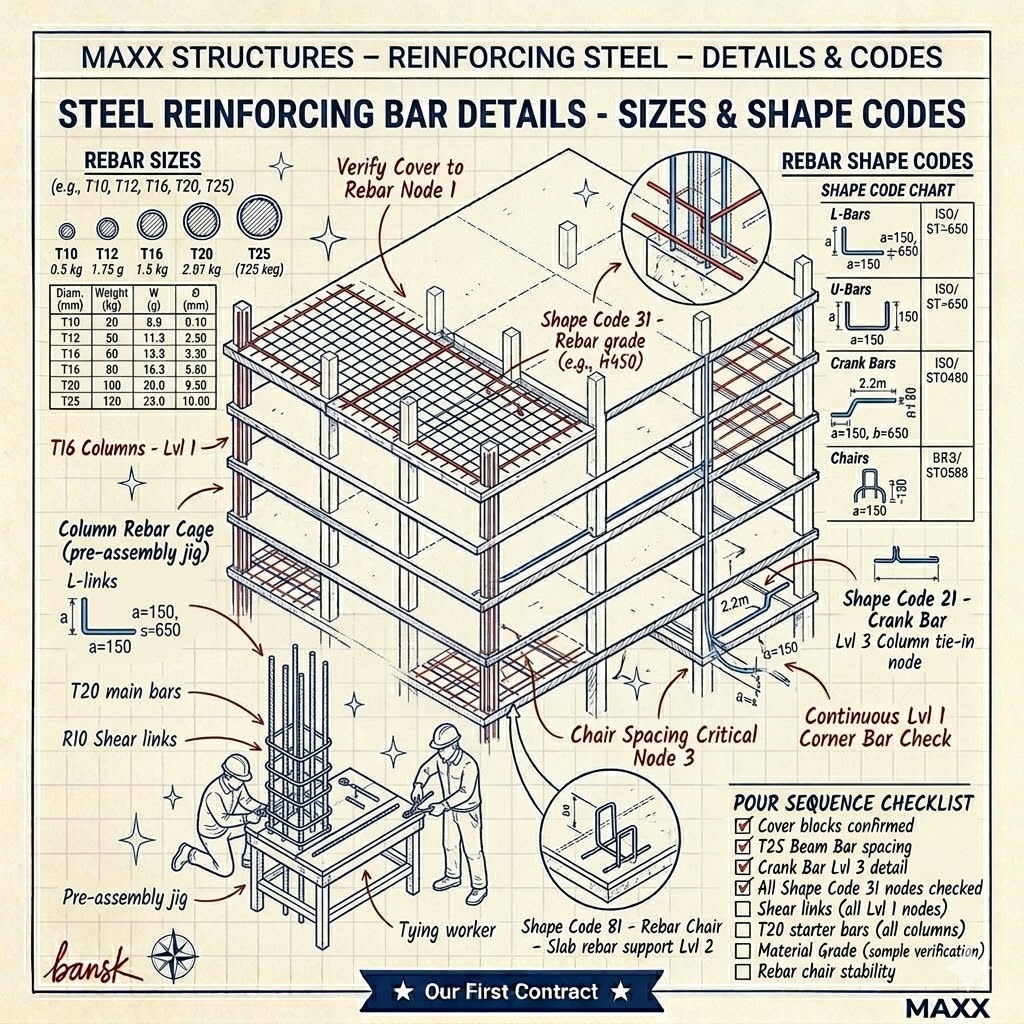
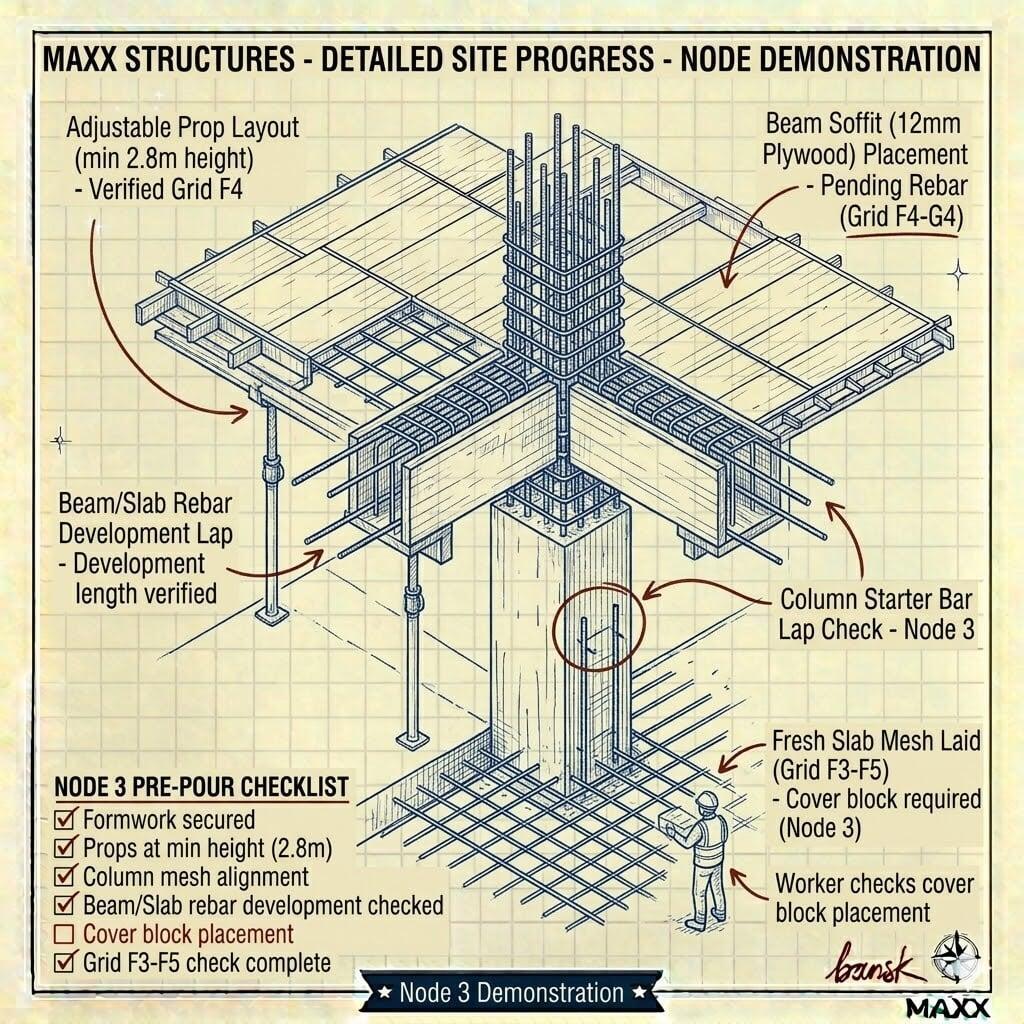
In building slabs, Steel Reinforcing (often referred to as rebar or "fixing") serves as the vital tensile strength of the structure. While concrete is exceptionally strong in compression (pushing), it is relatively weak in tension (pulling). Steel reinforcement is embedded within the concrete to absorb these tensile forces, preventing the slab from cracking or failing under load.
The Role in Slabs
For floor and roof slabs, steel is typically laid in a grid pattern (mesh or loose bars) at specific depths. Top reinforcement manages "negative" moments over support columns, while bottom reinforcement handles the "positive" sagging forces in the center of the span.
Specifications & Standards
To meet the Maxx Standard, all materials must comply with rigorous national safety requirements:
SABS Approved: All steel used is SABS 920 compliant (South African Bureau of Standards), ensuring the correct chemical composition, yield strength, and rib geometry for maximum concrete bond.
High-Tensile Strength: We primarily utilize Grade 500 MPa high-tensile steel, which provides superior load-bearing capacity compared to mild steel.
Available Sizes & Forms
Depending on the structural engineer's requirements, we supply and fix a wide range of diameters and formats:
| Type | Common Sizes (Diameter) | Typical Use Case |
| Rebar (Loose) | 8mm, 10mm, 12mm, 16mm, 20mm, 25mm, 32mm | Main structural support, columns, and heavy beams. |
| Welded Mesh | Ref 100, Ref 193, Ref 245, Ref 311, Ref 395 | Standardized grids for surface reinforcement and crack control. |
| Binding Wire | 1.6mm Black Annealed | Used to secure rebar intersections during the fixing process. |
The "Supply & Fix" Advantage
Under our model, we don't just drop steel on-site. We manage the Bending Schedule, ensuring every bar is cut and shaped to the exact millimeter before being fixed in place. By using only SABS-approved materials, we guarantee that the "skeleton" of your slab is built to withstand the specific coastal and environmental demands of the Western Cape.
How would you like to incorporate these technical specs? We could add them as a "Technical Compliance" section on your website or as a quality-assurance page for your tender documents.
FORMWORK SUPPLY, INSTALL & MANAGE
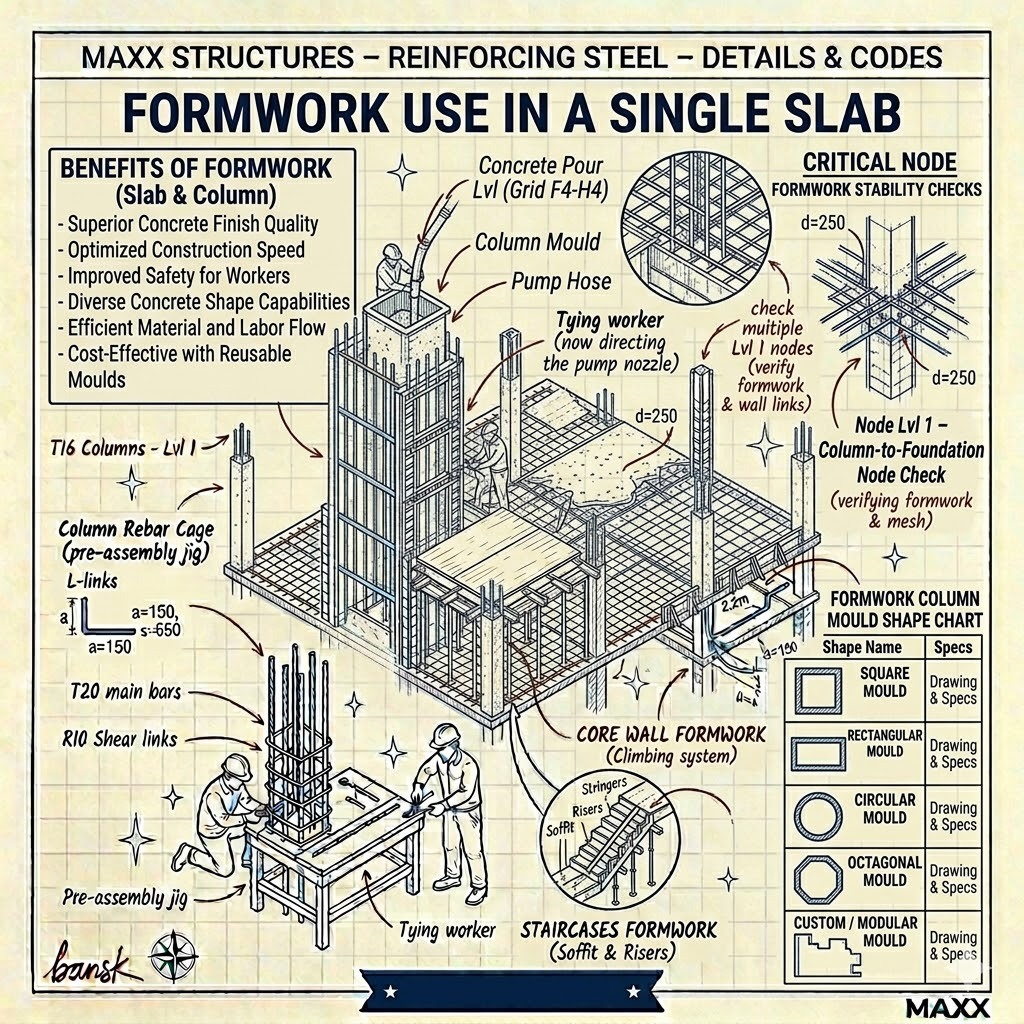
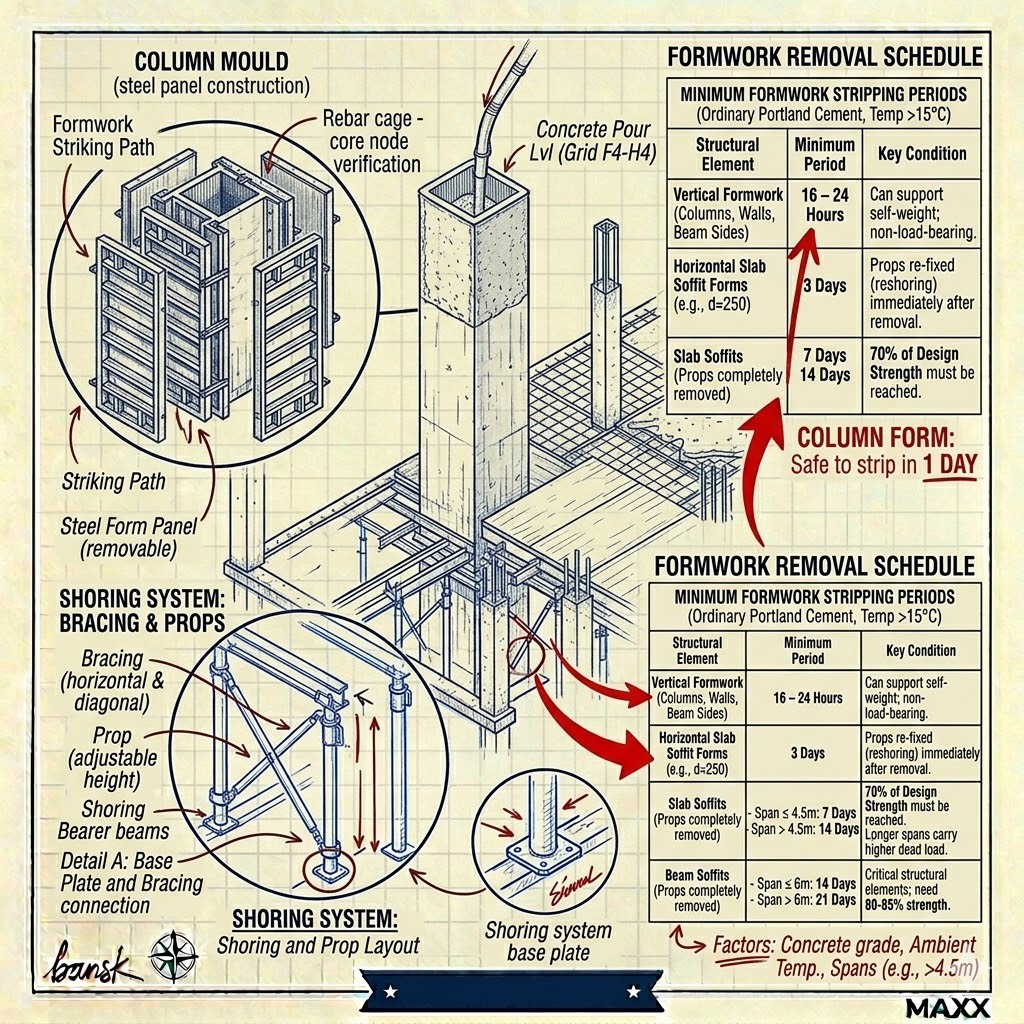
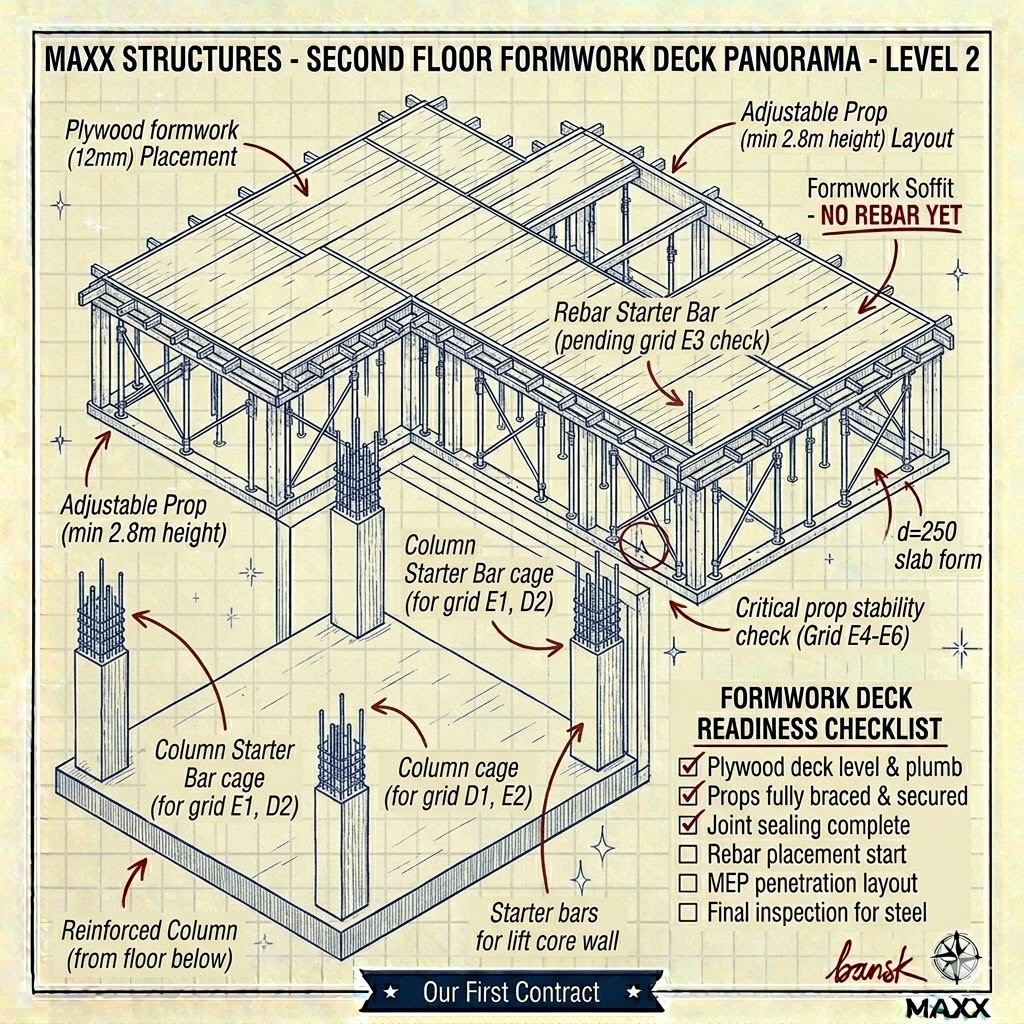
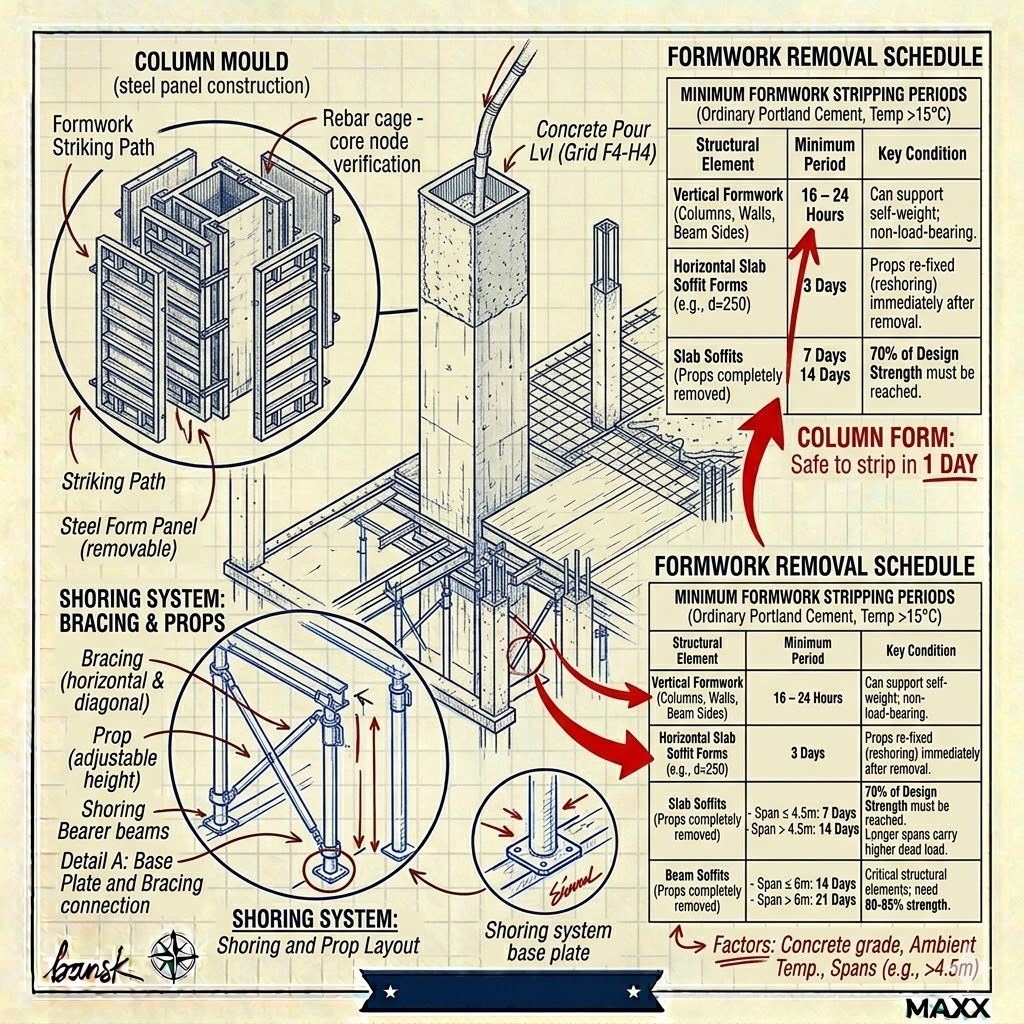
In modern construction, formwork is the temporary or permanent "mold" into which concrete is poured. For high-rise and commercial projects, modern formwork systems (often utilizing steel, aluminum, or high-density plastics) have largely replaced traditional timber due to their superior precision and speed.
Formwork Applications
1. Slabs (Decking)
In slab construction, formwork consists of a large horizontal surface supported by a system of props and beams.
Slab Soffits: This provides the underside finish of the floor.
Drop Heads: Special components that allow the main decking to be removed early while the primary supports stay in place, speeding up the construction cycle.
2. Columns & Pillars
Column formwork must withstand high internal pressure as concrete is poured from a height.
Adjustable Systems: Modern column forms are often modular, allowing General Managers to adjust dimensions for square, rectangular, or circular pillars without needing to rebuild the mold from scratch.
3. Walls & Cores
Used for lift shafts and stairwells, these large vertical panels are often "climbed" up the building as each floor is completed.
Benefits Over Traditional Wood Construction
While timber (wood) is still used for small-scale residential "shuttering," specialized formwork systems offer distinct advantages for professional builds:
| Feature | Modern System Formwork | Traditional Wood Construction |
| Durability | Can be reused hundreds of times. | Often discarded after 3–5 uses. |
| Finish Quality | Delivers a Fair-Face (smooth) finish, often requiring no plaster. | Frequently results in "honeycombing" or rough surfaces. |
| Speed | Modular components "click" together, saving hours of labor. | Requires time-consuming measuring, sawing, and nailing. |
| Precision | Engineered to the millimeter; no warping or bending. | Wood absorbs moisture and can warp or swell, leading to uneven slabs. |
| Safety | Designed with integrated walkways and guardrails. | Highly dependent on the skill and care of the individual carpenter. |
The Maxx Edge
At Maxx Structures, we treat formwork as the "Negative" of the final masterpiece. By moving away from rudimentary wood construction and utilizing engineered systems, we ensure that every slab is level and every column is perfectly plumb. This precision isn't just about aesthetics—it’s about ensuring the Steel Reinforcingand Concrete work in total unison to meet the Maxx Standard.
Would you like me to draft a comparison specifically for a client proposal to explain why your system is worth the investment over a cheaper "timber-only" contractor?

Strategic Partner: Superdecks Formwork
CONCRETE SUPPLY, MANAGE AND LAY
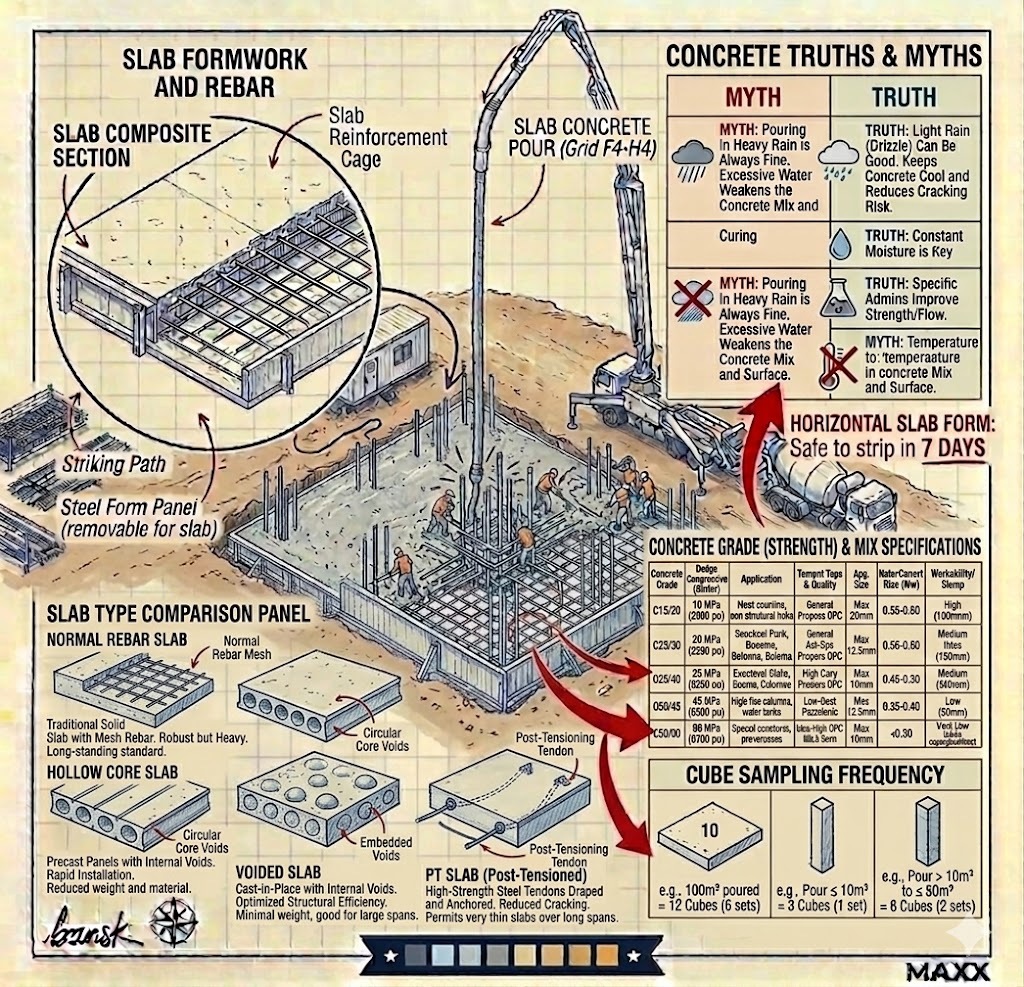
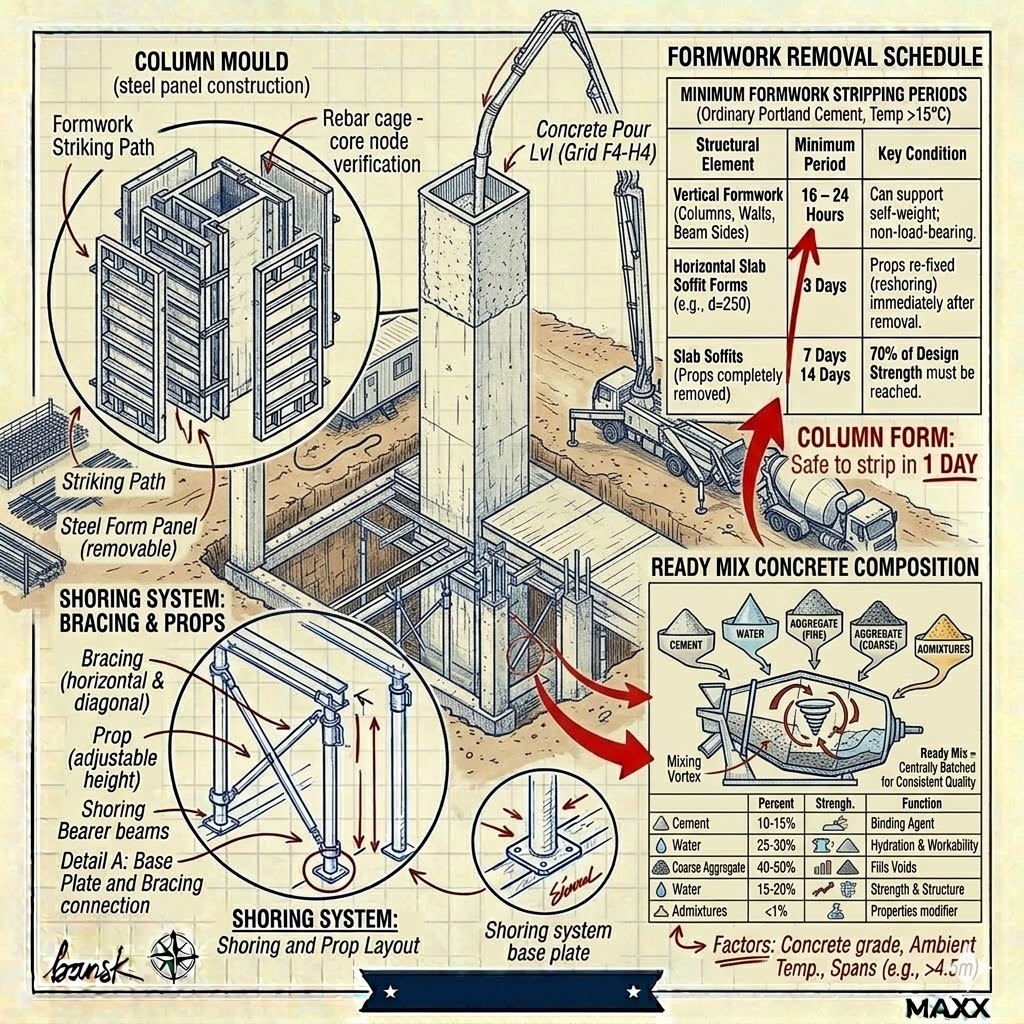
In the context of the Maxx Standard, concrete is the final, permanent realization of the structural design. While formwork and steel provide the shape and the skeleton, the concrete pour is the "moment of truth."
Concrete Applications
1. Slabs (The Floor & Ceiling)
In slab construction, concrete acts as a massive, rigid horizontal diaphragm. It provides the thermal mass, fire resistance, and acoustic insulation that timber simply cannot match. For building slabs, we focus on Grade 25 to 35 MPa (Mega Pascals) to ensure the surface can handle both static furniture loads and dynamic movement.
2. Columns (The Vertical Load-Bearers)
Concrete columns are the "legs" of the building. Because concrete is incredibly strong in compression, it is the ideal material to transfer the weight of multiple floors down to the foundations. High-strength concrete mixes are often used here to keep column sizes slim while maintaining massive load-bearing capacity.
Benefits Over Wood (Timber) Construction
While wood is a traditional building material, structural concrete is the industry standard for high-performance buildings for several key reasons:
| Feature | Structural Concrete | Wood (Timber) Construction |
| Longevity | Lasts for centuries with minimal degradation. | Prone to rot, termites, and moisture damage over time. |
| Fire Resistance | Naturally non-combustible; provides a high fire rating. | Requires expensive chemical treatments to slow ignition. |
| Spans & Strength | Can achieve massive open-plan spans (especially with PT). | Limited span lengths; requires more frequent support posts. |
| Acoustics | High density naturally blocks sound between floors. | Highly resonant; often requires complex layering to stop noise. |
| Maintenance | Virtually maintenance-free once cured and sealed. | Requires regular staining, sealing, or inspection for pests. |
The Maxx Precision Pour
The difference between a standard pour and a Maxx Structure lies in the Hydration Management. We ensure the concrete is vibrated correctly to remove air pockets (honeycombing) and cured under controlled conditions to prevent shrinkage cracks.
By choosing concrete over wood, you aren't just building for today—you are creating a "rock-like structural mass" that will remain level, quiet, and safe for the lifetime of the building.
How would you like to use this comparison? It works particularly well in a "Why Choose Us" section for clients who are weighing up different construction methods for their Western Cape developments.

Strategic Partner: Solid Cube Ready Mix (Pty) Ltd
POWER FLOATING CONCRETE
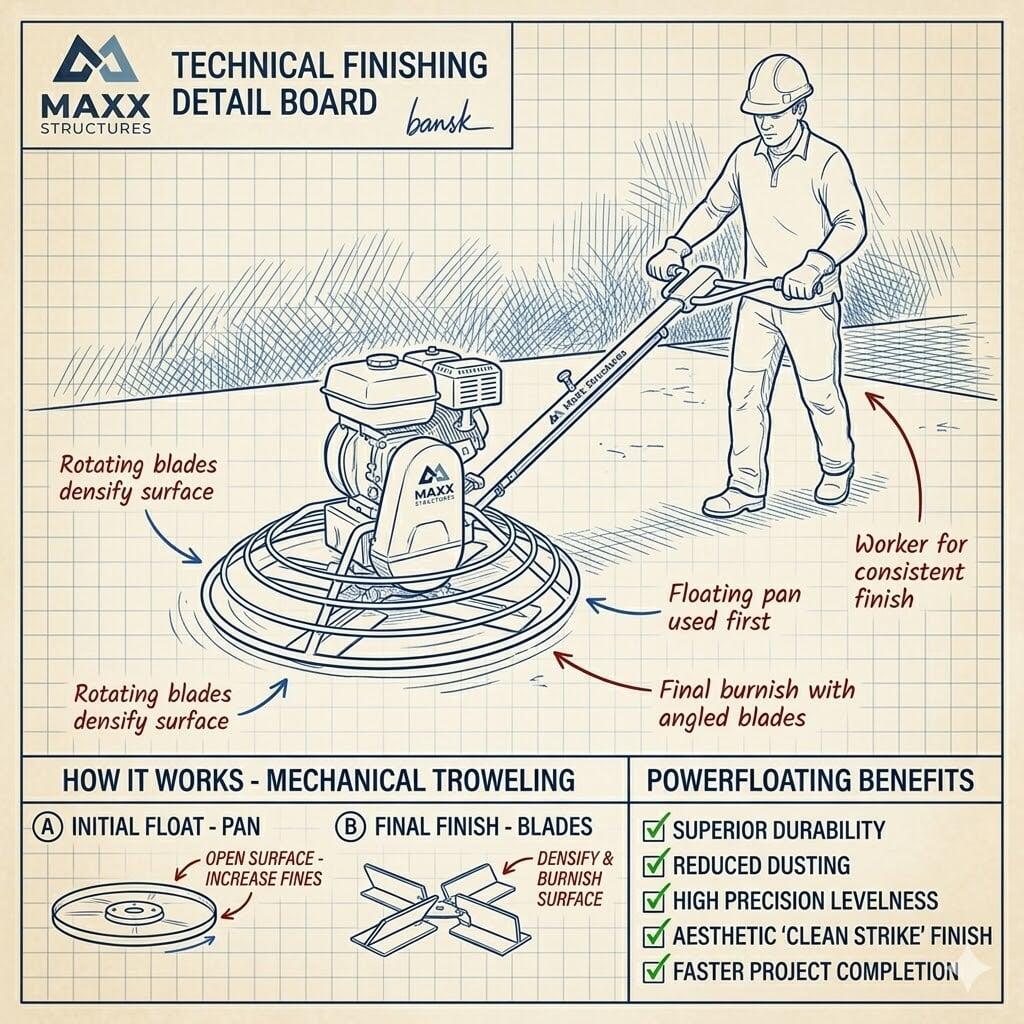
Powerfloating (also known as "trowelling") is the mechanical process used to achieve a smooth, dense, and highly level finish on green concrete slabs. It is the final stage of the concrete trade, occurring after the pour but before the concrete has fully hardened.
The Process
As the concrete begins to set and can support the weight of a person (leaving only a shallow footprint), a power trowel—a machine with rotating steel blades—is used.
The Float Phase: Initially, "float pans" or wide blades are used at a low speed to flatten high spots, fill in hollows, and pull "fat" (cement paste) to the surface.
The Finish Phase: As the slab hardens, the operator switches to finishing blades at a higher speed and angle. This compacts the surface, closing the pores and creating a hard-wearing, polished-look finish.
Key Benefits of Powerfloating
Increased Durability: The mechanical action compacts the surface, making it significantly more resistant to abrasion and heavy foot or vehicle traffic.
Aesthetic Appeal: It eliminates the rough, "broomed" texture of standard concrete, resulting in a smooth, professional, and modern appearance.
Reduced Maintenance: A powerfloated surface is much denser, meaning it absorbs less liquid and is easier to sweep and clean.
Precision Levelling: It is the most effective way to ensure a "Superflat" floor, which is essential for warehouses, retail spaces, and modern residential slabs.
The Maxx Standard: Precision Timing
At Maxx Structures, we know that powerfloating is all about timing. If you start too early, you ruin the surface; if you start too late, the concrete is too hard to manipulate. We monitor the hydration process closely to hit that "sweet spot," ensuring the final product isn't just a slab, but a perfectly finished surface that participants are "happy to put their stamp to."
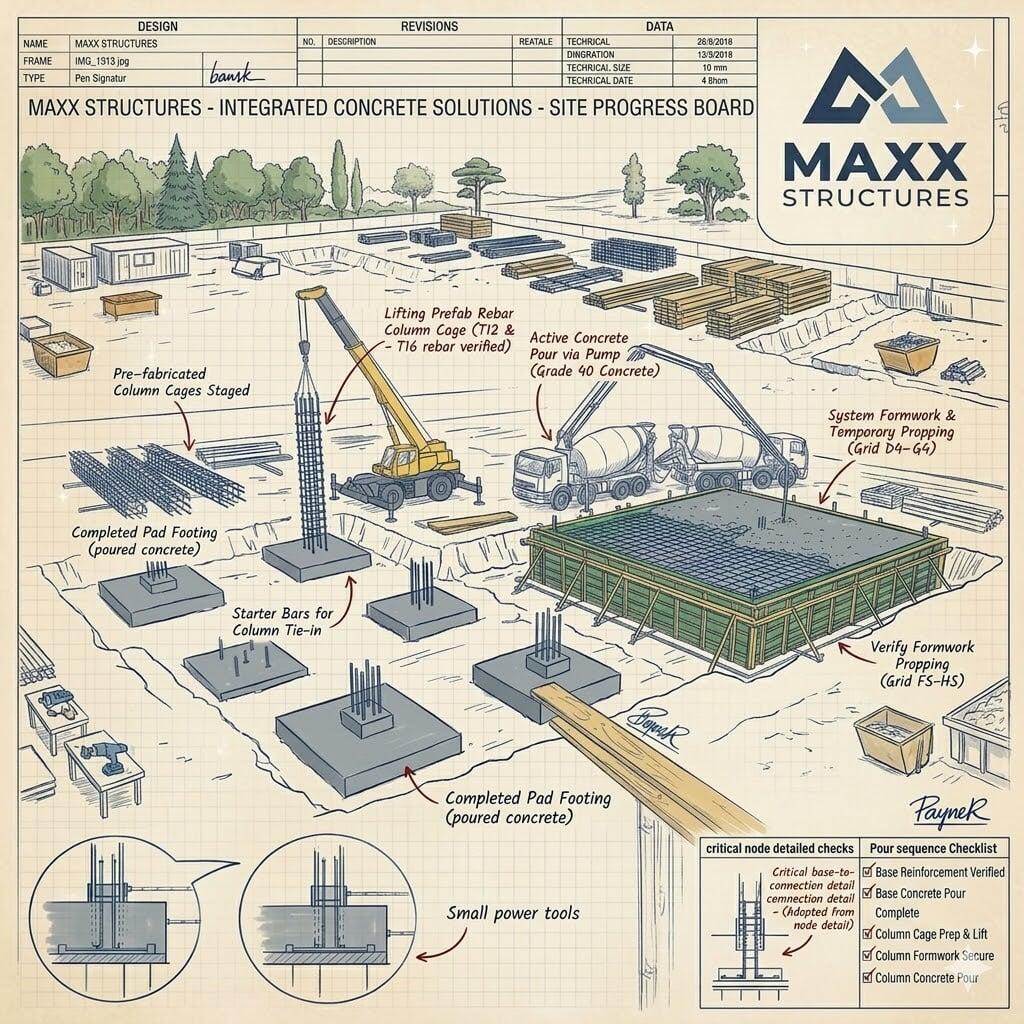
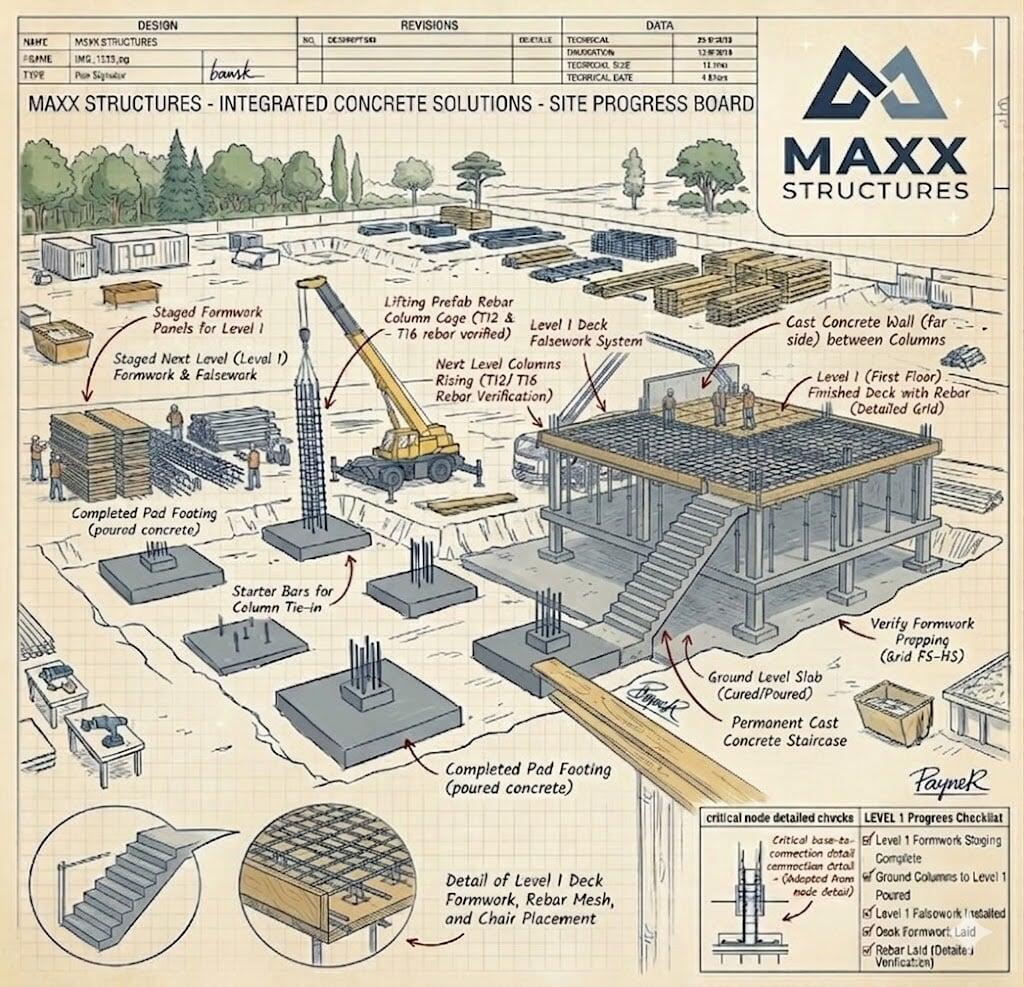
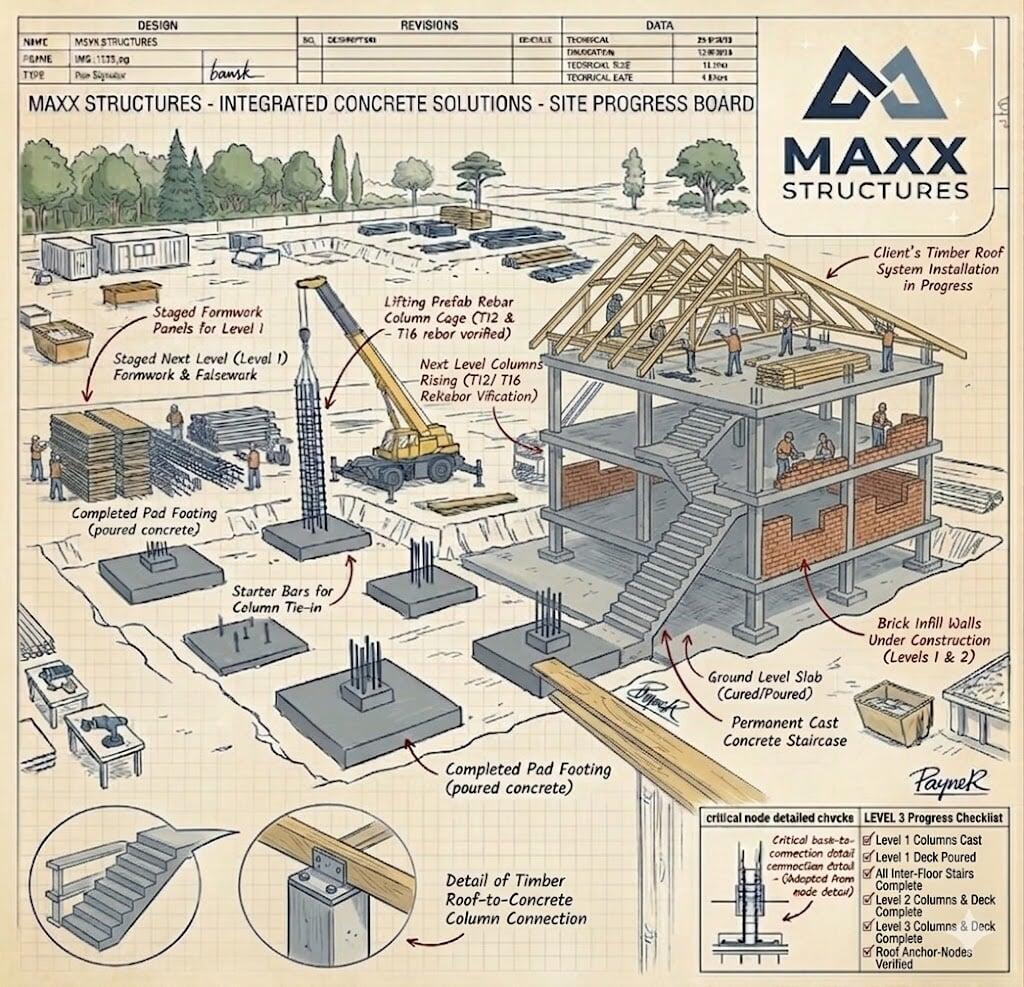
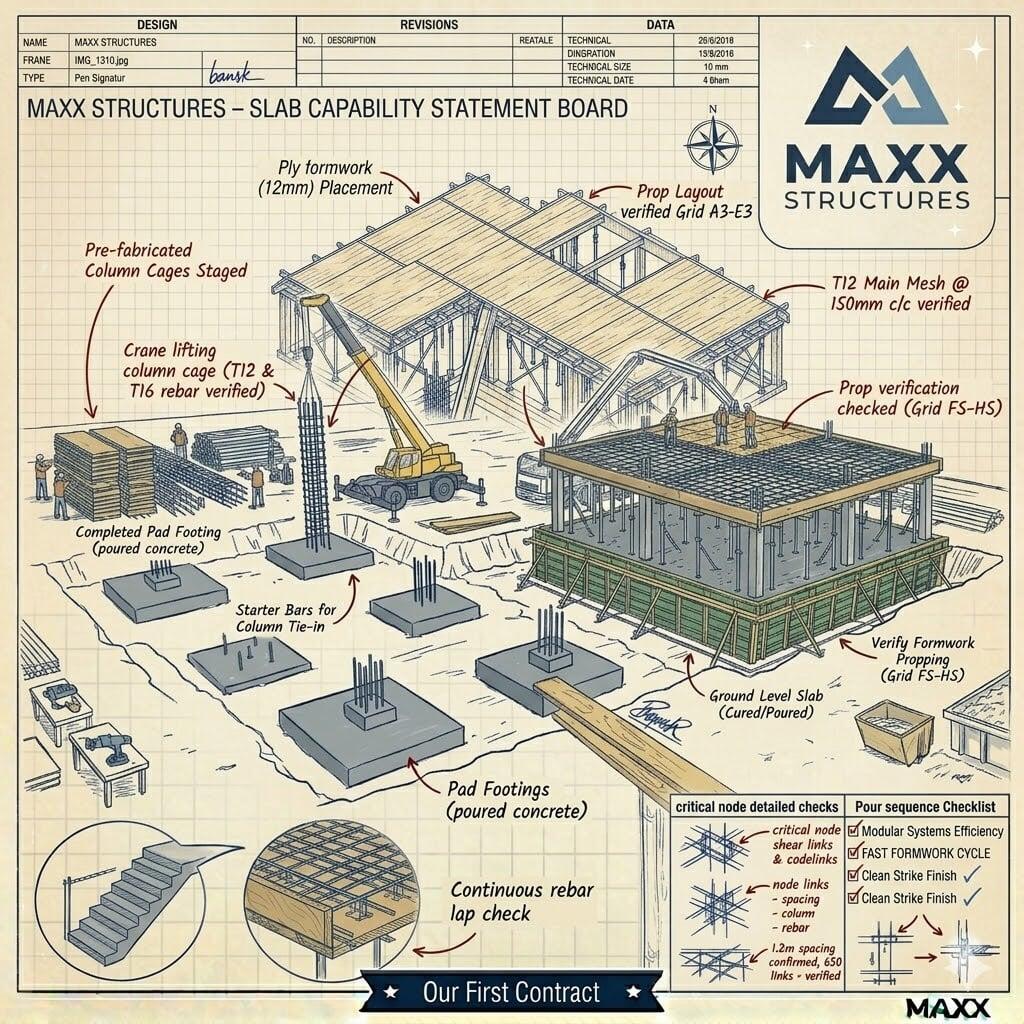
FULL CONCRETE STRUCTURES - STEEL/FORMWORK/CONCRETE (SFC)
The Maxx Effect is the measurable difference a client feels when they shift from managing multiple, conflicting trades to partnering with a single, accountable structural specialist. It is the transition from "site chaos" to "engineered precision."
For a customer choosing Maxx Structures, the effect manifests in four primary ways:
1. The Removal of "Trade Friction"
In traditional construction, the formwork carpenter blames the steel fixer, and the steel fixer blames the concrete supplier for delays or errors.
The Maxx Effect: We own all three. By synchronizing these trades in unison, we eliminate the "butting of heads." The customer no longer has to mediate disputes or manage the gap between different subcontractors.
2. Compressed Project Timelines
Because we manage the interplay between the trades, we can optimize the cycle time of a slab.
The Maxx Effect: We don't wait for a third-party steel fixer to show up before the formwork is finished. Our teams operate as a single unit, allowing us to move from shuttering to pouring faster than a fragmented site team could, getting the "structural backbone" finished ahead of schedule.
3. Technical Peace of Mind (The SABS Guarantee)
Many contractors cut corners on material grades to save costs.
The Maxx Effect: The customer knows that every kilogram of steel is SABS-approved and every cubic meter of concrete is the exact MPa grade specified by the engineer. We provide a paper trail of quality that protects the developer’s long-term investment and reputation.
4. Financial Predictability
Managing multiple trades often leads to "hidden costs" and variations when one trade's mistake affects another.
The Maxx Effect: A single-source turnkey quote means fewer surprises. We provide a comprehensive price for the entire structural shell, giving the customer a fixed target for their budget and reducing the risk of costly site instructions and rework.
The Bottom Line: The Maxx Effect means that when we hand over the keys to the structure, the client isn't just getting a building—they are getting a product that met the Maxx Standard long before they even walked through the door. It is the confidence that the most critical phase of their build was handled with total site accountability.

STRATEGIC PARTNER: NEXU (PTY) LTD
Our rapid expansion and operational capacity are powered by a strategic partnership with Nexu, a specialist in construction funding. This collaboration provides Maxx Structures with the robust financial backing necessary to scale our services, secure premium materials at volume, and take on high-impact developments across the Western Cape. By leveraging Nexu’s industry-focused capital, we ensure that our project timelines remain aggressive and our commitment to quality is never compromised by liquidity constraints.
Reinforcing Mesh
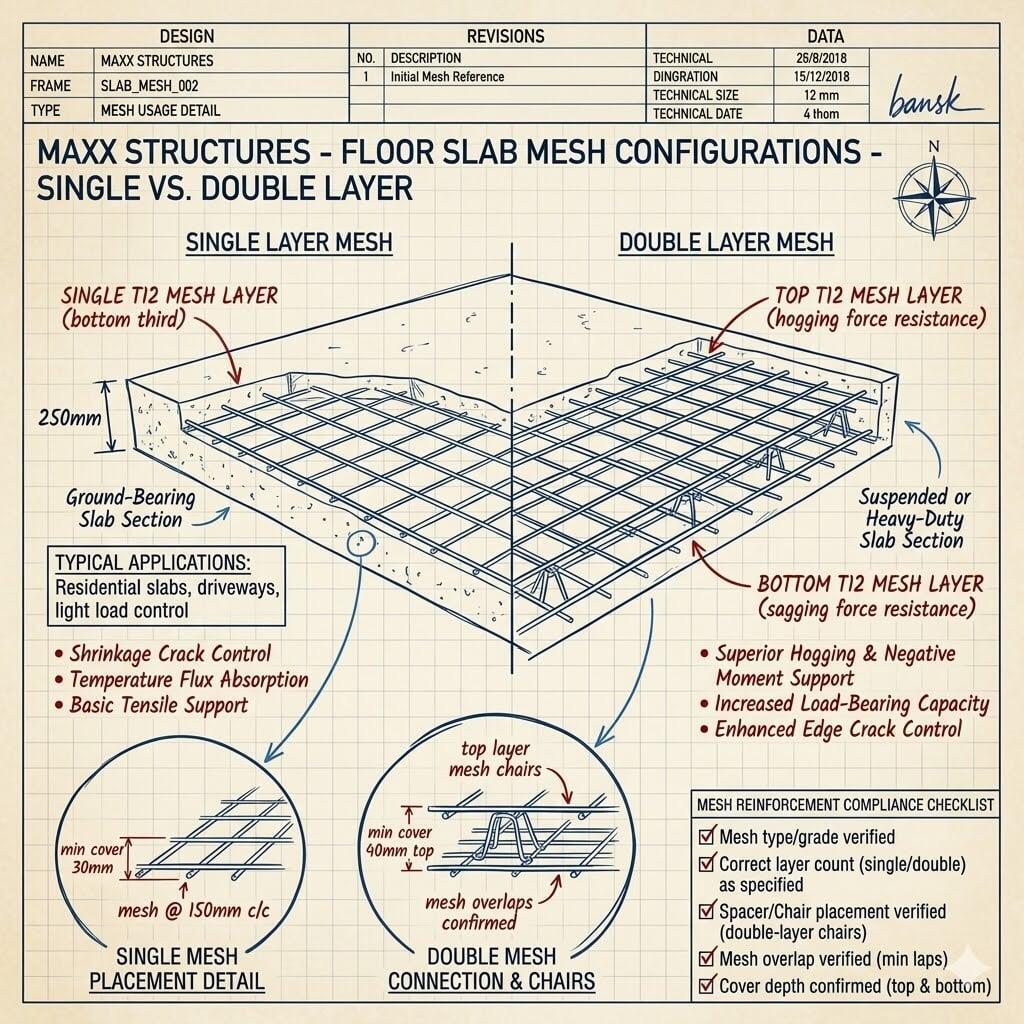
Reinforcing mesh (or welded wire fabric) is a prefabricated grid of longitudinal and transverse wires, electrically resistance-welded at every intersection. In construction, it serves as the essential "secondary" reinforcement that provides consistent strength across large, flat surface areas.
Primary Uses in Construction
1. Surface Crack Control (Shrinkage)
The most common use for mesh in building slabs is to manage drying shrinkage. As concrete cures, it loses moisture and naturally wants to contract. The mesh acts as a restraint, distributing the internal stresses evenly across the slab to prevent large, unsightly cracks from forming.
2. Ground-Slab Reinforcement
For driveways, warehouse floors, and residential "rafts," mesh provides the necessary tensile strength to handle light-to-medium loads. It ensures the slab remains a single, cohesive unit even if the soil beneath it shifts slightly.
3. Topping Slabs & Screeds
Mesh is often used in thin concrete toppings placed over insulation or pre-cast planks. It adds structural integrity to these thinner layers, preventing them from curling or breaking under foot traffic.
Key Benefits for the Maxx Standard
Speed of Installation: Unlike loose rebar that must be tied bar-by-bar, mesh comes in large sheets (standard size 2.4m x 6m in South Africa). This allows our teams to cover massive areas in a fraction of the time, keeping your project on its "rigorous pace."
Uniformity: Because the grid is factory-welded, the spacing between wires is 100% consistent. This guarantees that the reinforcement is exactly where the engineer specified it, with no human error in spacing.
SABS Compliance: At Maxx Structures, we only utilize SABS-approved mesh (ranging from Ref 100 to Ref 395). This ensures the steel has the correct ductile properties to move with the concrete without snapping.
Common Mesh References
| Reference | Wire Diameter | Typical Use |
| Ref 100 | 4.0mm | Light residential walkways / DIY |
| Ref 193 | 5.6mm | Standard residential house slabs |
| Ref 245 | 6.3mm | Heavy-duty driveways / Small workshops |
| Ref 395 | 8.0mm | Industrial floors / High-load commercial slabs |
The Maxx Perspective:
While many contractors simply "throw in some mesh," we focus on correct positioning. Using specialized "spacers" or "stools," we ensure the mesh is suspended in the top third of the slab where it is most effective at fighting cracks. If it’s sitting on the dirt, it’s not doing its job—and that wouldn't meet the Maxx Standard.
Would you like to include a specific "Material Quality" section in your website describing these SABS-approved mesh options?
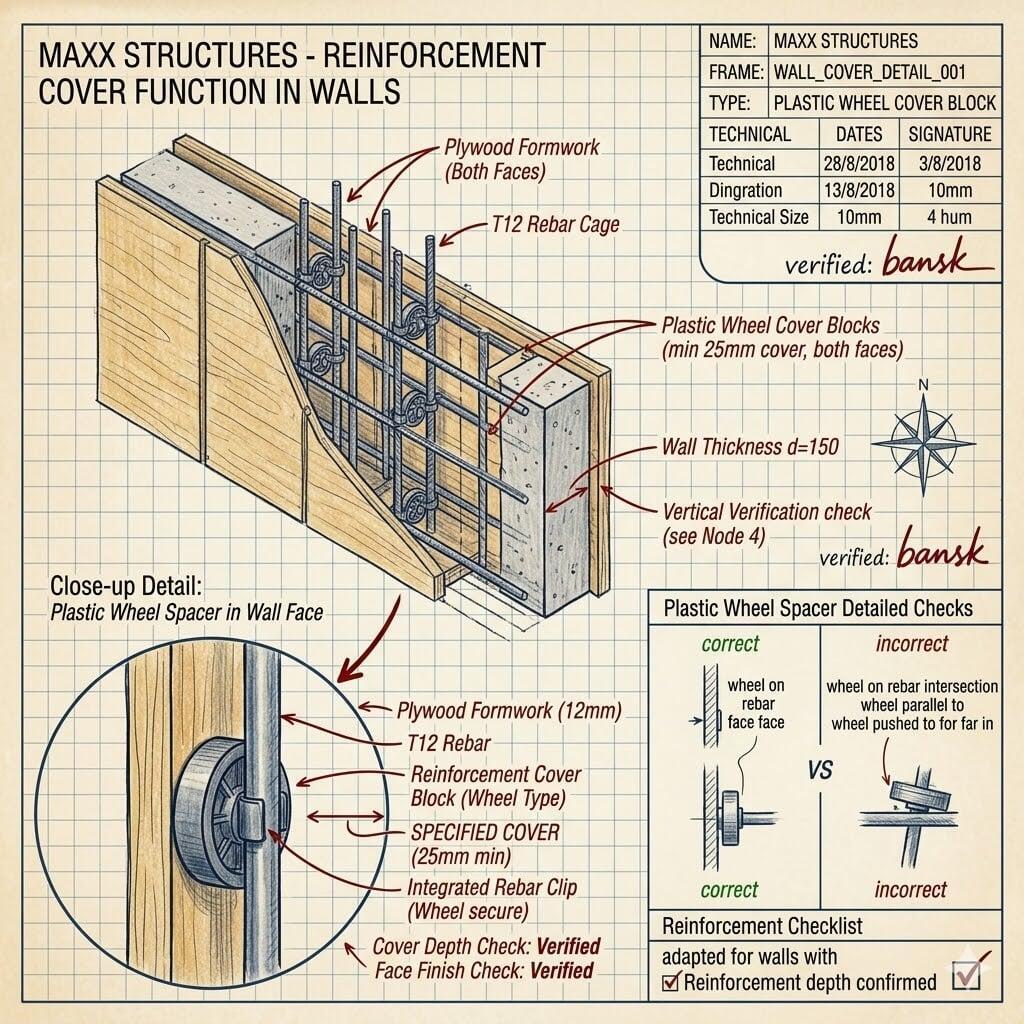
Plastic & Concrete Spacers
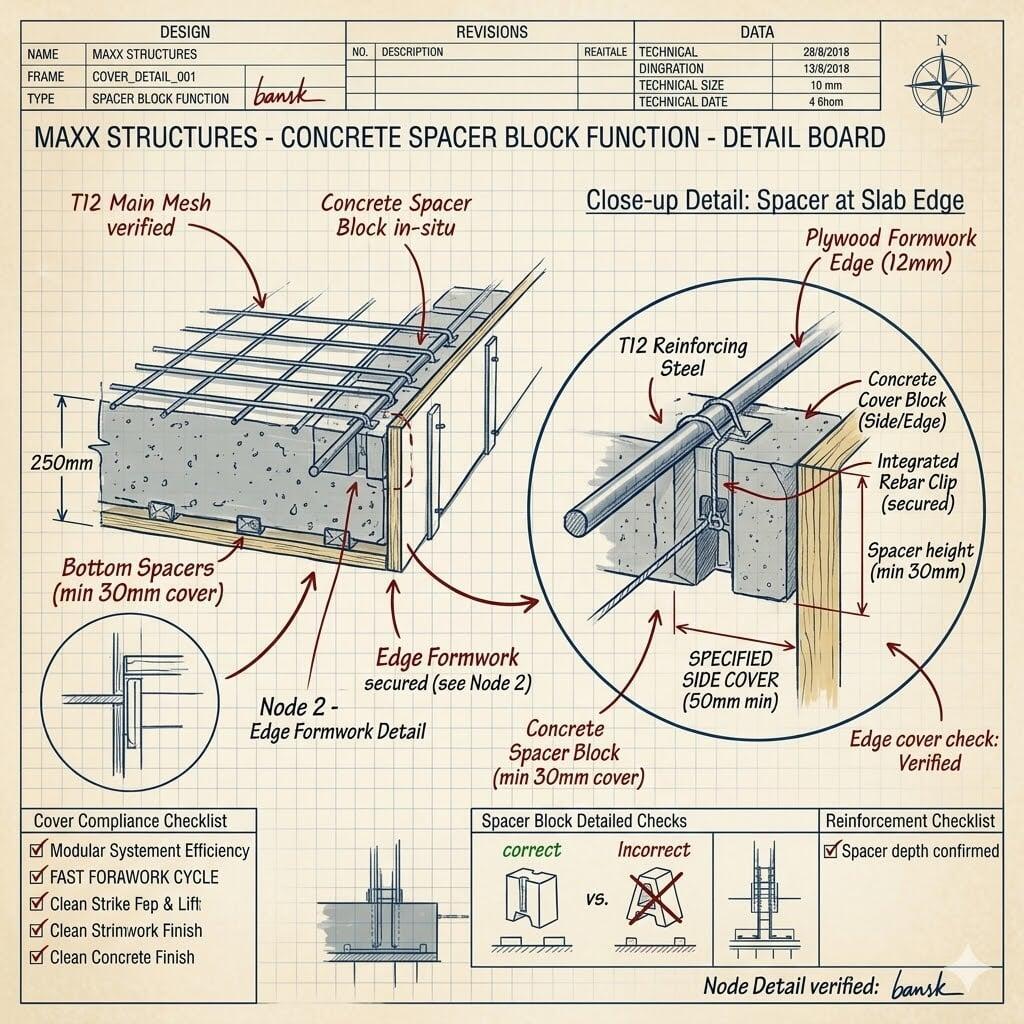
In the world of the Maxx Standard, the most important part of a structure is often what you don't see once the concrete is poured. Spacers (also known as "cover blocks" or "stools") are the small but critical components used to maintain the "concrete cover"—the precise distance between the steel reinforcement and the surface of the concrete.
The Purpose of Spacers
Steel must be encased in a specific depth of concrete to protect it from corrosion (rust) and fire. If the steel is too close to the edge, moisture can reach it, causing the rebar to expand as it rusts, which eventually "spalls" or cracks the concrete from the inside out.
1. Concrete Spacers (Cover Blocks)
These are heavy-duty spacers made from high-strength cementitious material, designed to bond perfectly with the poured concrete.
Best For: Heavy reinforcement, foundations, and high-load columns.
Benefits:
Uniformity: Because they are made of concrete, they have the same thermal expansion coefficient as the slab, preventing "weak spots."
High Load-Bearing: They won't crush under the weight of heavy rebar or site teams walking on the mesh.
Fire Resistance: Offers the highest level of fire protection for the steel.
2. Plastic Spacers
These are lightweight, versatile spacers available in various shapes, such as "wheels" for vertical columns or "castles" for horizontal slabs.
Best For: Wall reinforcement (columns/pillars), lighter mesh, and pre-cast elements.
Benefits:
Versatility: "Wheel" spacers clip onto the bars, ensuring the steel remains centered even as concrete is poured into a deep column form.
Speed: They are fast to install and snap easily onto different bar diameters.
Non-Corrosive: Being plastic, they will never rust or react with the concrete environment.
The Maxx Perspective: Precision Cover
At Maxx Structures, we don't allow steel to simply rest on the formwork. We utilize the correct spacer for the specific environment—especially in the Western Cape, where the coastal air is high in chlorides.
We ensure 40mm–50mm cover for coastal exposure.
We ensure spacers are placed at strict intervals to prevent the steel from "sagging" under the weight of the fresh concrete.
Using the right spacers is a non-negotiable part of the Maxx Effect—it ensures the structure lasts for decades without maintenance.
Do you typically prefer using concrete blocks for your heavy slabs, or do you find the modular plastic "castles" more efficient for your current site pace?
Post-Tensioning
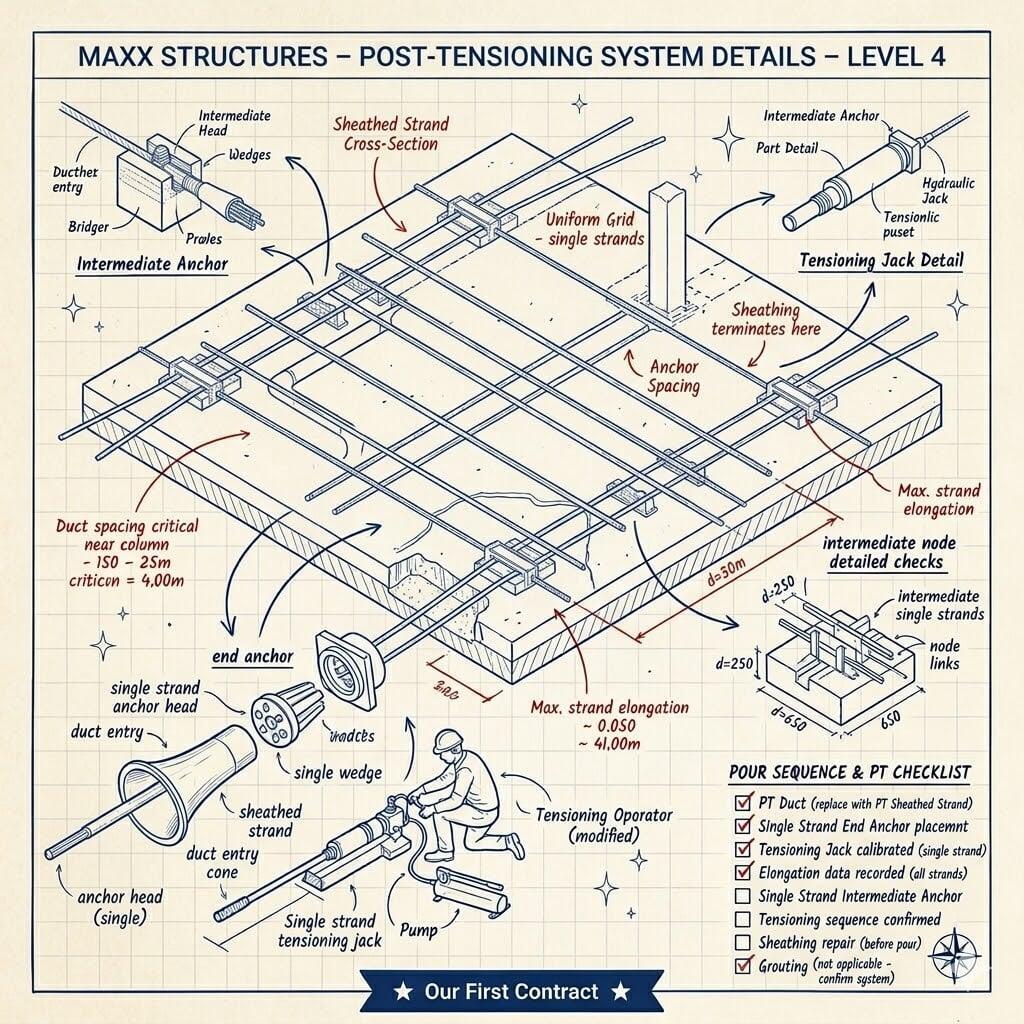
Post-tensioning (PT) is a sophisticated method of reinforcing concrete that introduces internal compressive stress to the slab before it is even put under a full load. While standard reinforcing (rebar) is passive, PT is active—essentially "squeezing" the slab together to make it significantly stronger and more efficient.
The Post-Tensioning Process
Layout: High-strength steel cables (tendons), encased in protective ducts, are laid out in a specific profile—usually a draped, wave-like shape—within the formwork.
The Pour: Concrete is poured into the formwork, surrounding the tendons.
Tensioning (The "Post" Part): Once the concrete has reached a specific strength (but before it is fully cured), the tendons are pulled tight using hydraulic jacks and anchored to the edges of the slab.
Compression: This "pulling" creates a permanent compressive force that offsets the tensile stresses that occur when the building is loaded with weight.
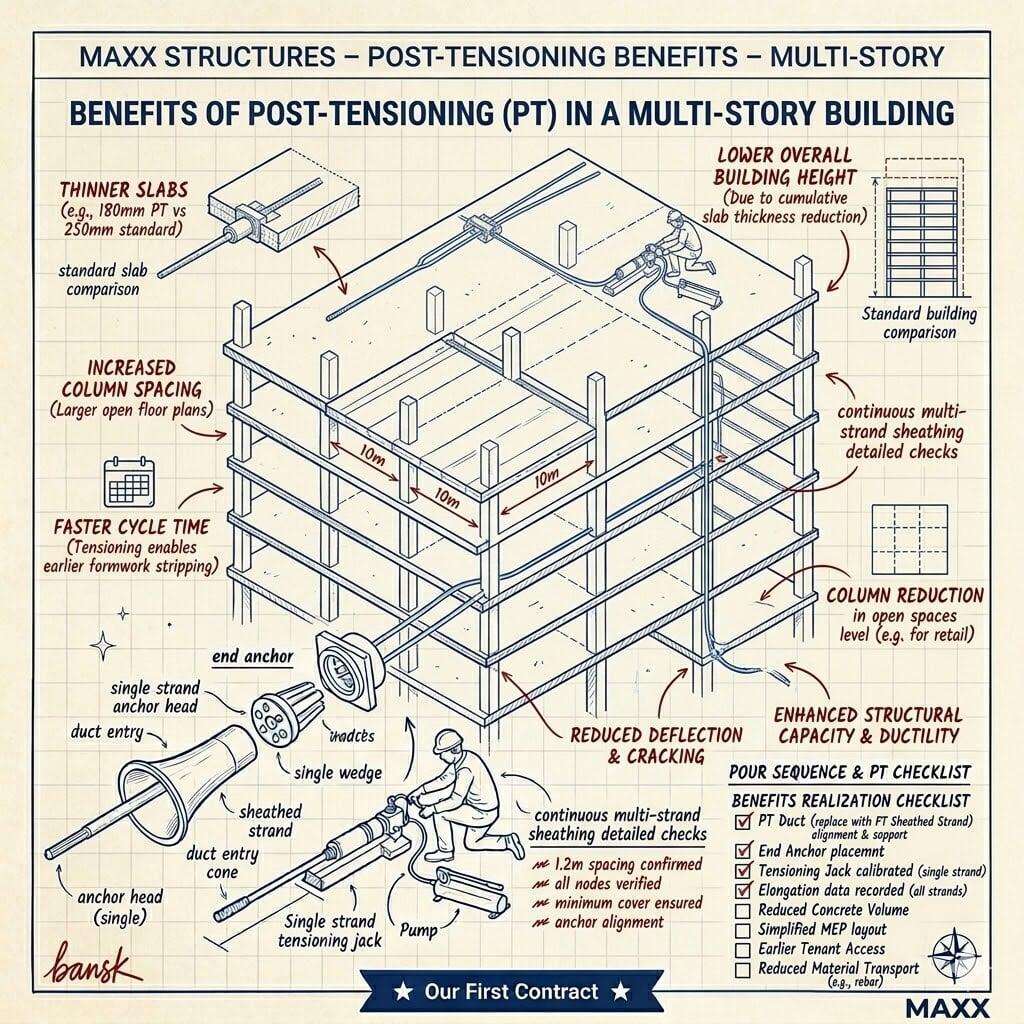
Key Advantages for Building Slabs
Thinner Slabs: PT allows for thinner concrete slabs without sacrificing strength, which reduces the overall weight of the building and saves on material costs.
Longer Spans: Because the slab is more efficient, you can have larger distances between support columns. This is why PT is the standard for open-plan offices and parking garages.
Deflection & Crack Control: The internal "squeeze" helps keep the concrete tight, significantly reducing the likelihood of sagging (deflection) and surface cracking.
Height Savings: Thinner slabs across many floors can reduce the total height of a high-rise, potentially saving enough space to add an entire extra floor within the same building envelope.
The Maxx Perspective
In the context of the Maxx Standard, Post-Tensioning represents the pinnacle of the "Three Trades in Unison." The formwork must be precise to house the tendons, the steel (tendons and burst reinforcement) must be placed with surgical accuracy, and the concrete pour must be flawless to ensure the chemical hydration provides the necessary strength for the tensioning phase.
How does PT fit into your current service offering—is it something you plan to handle in-house or through specialized partners?
OTHER STEEL PRODUCTS
CONSTRUCTION PRODUCTS
OTHER PRODUCTS
Partner With Us To Build a Resilient Business
You can edit text on your website by double clicking

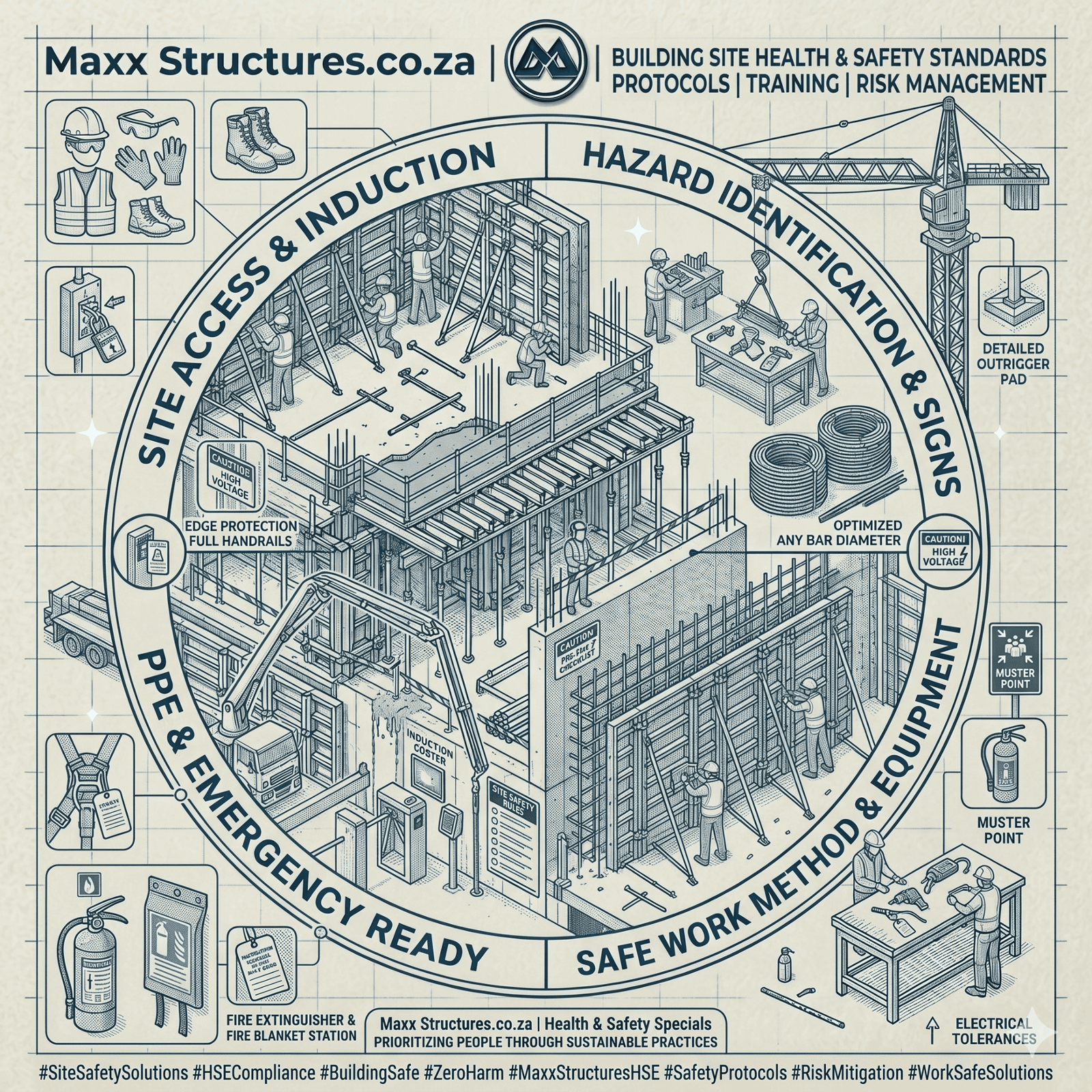
Health & Safety
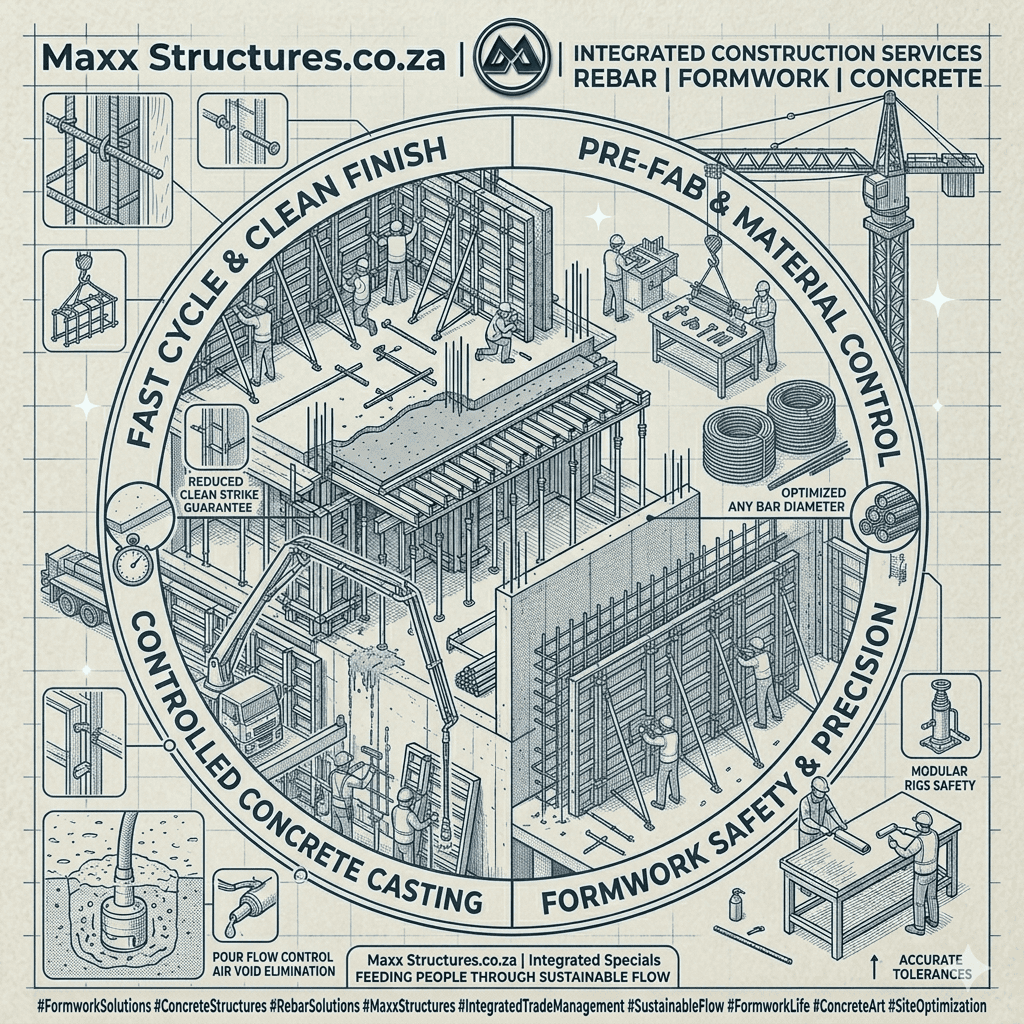
Steel Reinforcing / Formwork / Concrete Management
Our Project Management for comprehensive concrete structures is built on the principle of absolute technical accountability, whether we are overseeing the entire structural shell or managing individual trades. We take a holistic view of the construction cycle, synchronizing the delivery of SABS-approved steel, the erection of precision formwork, and the critical timing of concrete pours to eliminate the common friction points between separate contractors. By acting as the central nervous system for these core activities, we ensure that every structural element—from the foundation to the final slab—aligns perfectly with your architectural vision and engineering tolerances.
Flexibility is a cornerstone of our service model, allowing clients to engage our management expertise individually or as a cohesive whole. We understand that some projects require a turnkey sub-contractor to own the entire structural backbone, while others may only need specialized oversight for a specific phase, such as complex steel reinforcing or high-tolerance power floating. Regardless of the scope, our project management team applies the same rigorous site supervision, adherence to Western Cape safety regulations, and "Just-in-Time" logistics to keep your project on the critical path and ensure a seamless transition from liquid concrete to a precision-engineered structural element.
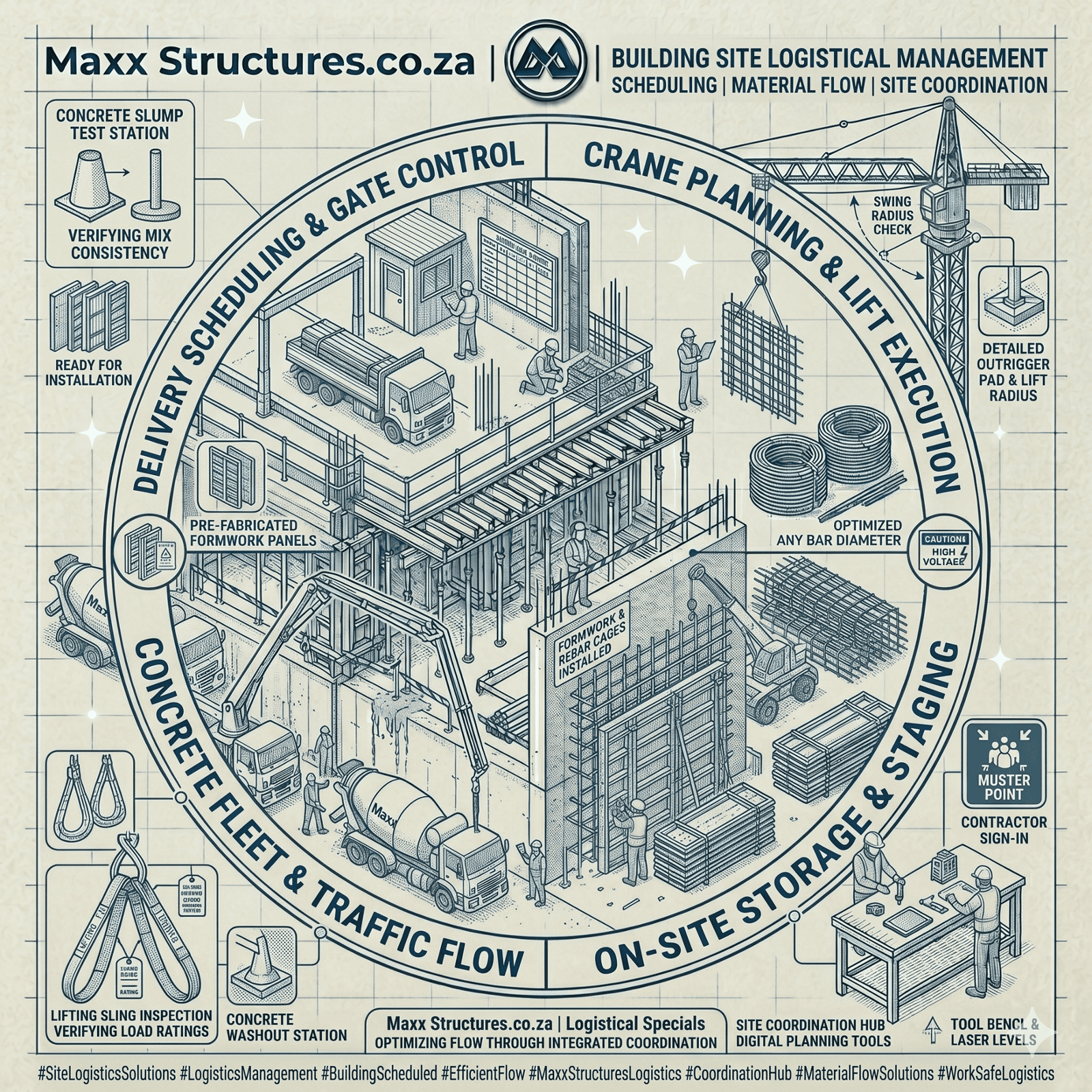
Logistical Management
Our Logistical Management for concrete structures is engineered to eliminate the downtime typically associated with multi-vendor coordination. We provide a "Just-in-Time" supply chain that ensures SABS-approved steel reinforcing, precision formwork systems, and high-performance concrete arrive on-site in perfect synchronization with your project’s critical path. By acting as a single point of contact for these essential materials, we reduce site congestion and mitigate the risks of material shrinkage or loss. Our logistics team handles the complex scheduling of truck rotations and crane time, ensuring that the structural shell progresses without the bottlenecks that often delay major developments in the Western Cape.
This robust logistical framework is designed to be modular, allowing you to engage our services individually or as a comprehensive whole. Whether you require the full-scale management of a turnkey structural package or targeted logistical oversight for a specific trade—such as the specialized transport and handling of heavy steel reinforcing—we apply the same rigorous standards of efficiency. By integrating our delivery timelines with your construction milestones, we provide the flexibility to scale our involvement based on your site's unique demands, ensuring that the backbone of your build is supported by a reliable, localized supply network.